
These machines handle what rotary screw and reciprocating designs simply cannot at scale - delivering thousands of CFM of inherently oil-free air, continuously, without the vibration and wear-part complexity of positive-displacement alternatives.
This guide covers how centrifugal compressors work, their core advantages for industrial automation, the applications they excel in, how they compare to rotary screw alternatives, and what it takes to keep them running reliably.
Key Takeaways:
- Centrifugal compressors use dynamic compression - impeller-driven - not positive displacement
- They deliver inherently oil-free air, critical for food, pharma, and semiconductor applications
- CAGI documents typical turndown of 30–40%, meaning they need stable base-load demand
- Hybrid systems pairing centrifugal base-load with variable-speed screw trim compressors are the preferred large-plant design
- Surge protection and load-sharing control are non-negotiable for multi-unit centrifugal installations
How Centrifugal Air Compressors Work
Dynamic Compression vs. Positive Displacement
Centrifugal compressors operate on a fundamentally different principle than rotary screw or reciprocating designs. Instead of trapping a fixed volume of air and squeezing it, centrifugal machines continuously accelerate air using a high-speed rotating impeller. That kinetic energy is then converted into pressure inside a diffuser - no piston cycles, no intermittent discharge pulses.
Three core components make up each compression stage:
- Impeller - draws air in axially and accelerates it radially outward at high velocity
- Diffuser - slows the accelerated airflow, converting velocity into static pressure
- Volute (collector) - gathers the pressurized air leaving the diffuser and routes it to the outlet or next stage

Multi-Stage Pressure Build-Up
Pressure builds progressively across stages. Typical multi-stage centrifugal staging breakdown is:
| Stages | Pressure Range |
|---|---|
| Single-stage | Up to 2.5 bar |
| Two-stage | 2.5–5.5 bar |
| Three-stage | 6–13 bar |
| Four to eight stages | Up to 205 bar |
This staging flexibility covers everything from standard 6-bar plant air networks to high-pressure process gas applications exceeding 200 bar - without switching compressor technology.
Operating Speeds and Efficiency
Impeller speeds vary significantly by design type. Industrial magnetic-bearing turbo units (such as those from Tamturbo) operate up to 35,000 RPM, while high-speed oil-free turbo designs push far higher. Celeroton's gas-bearing models, for example, run between 130,000 and 260,000 RPM.
These extreme speeds require precision bearing systems matched to the design:
- Conventional geared designs: hydrodynamic journal and thrust bearings
- Oil-free turbo designs: active magnetic bearings or gas (air foil) bearings
Centrifugal compressor efficiency generally falls in the 70–85% range. Larger machines benefit from a scale effect - tighter dimensional tolerances and reduced relative surface roughness improve both volumetric and friction efficiency, so bigger installations typically run closer to the upper end of that range.
Key Advantages of Centrifugal Compressors for Industrial Automation
High-Volume Continuous Flow
Centrifugal compressors are built for large, steady air demand. OEM flow ranges reflect how large these machines can get:
- Typical single-stage centrifugal packages: roughly 2,300-46,000 CFM at low pressure
- FS-Elliott Polaris: 900–20,000 CFM, up to 250 psig
- Multi-stage industrial centrifugal lines: roughly 2,500-135,000 CFM at higher pressures
These aren't machines for intermittent or small-demand applications. They're designed for plants running continuous-process automation where the compressor never really stops.
Inherently Oil-Free Air
Because the impeller mechanism compresses air without lubricant in the air path, centrifugal compressors deliver oil-free air by design. This matters enormously in industries where contamination causes real consequences:
- Food and beverage: oil contamination ruins product and violates food safety standards
- Pharmaceutical production: regulatory compliance requires documented air purity
- Semiconductor fabrication: trace oil aerosols damage yield-critical processes
- Medical device manufacturing: contamination can trigger product recalls
Per CAGI, centrifugal compressors can supply oil-free air meeting ISO 8573-1 Class 0 requirements - though Class 0 is a certification claim tied to specific equipment and documented testing, not an automatic guarantee for every installation.

For facilities where documented certification is a procurement requirement, Gardner Denver's oil-free rotary screw lines (EnviroAire T/TVS, PureAir T/TVS) carry ISO 8573-1 Class 0 certification. Comp-Air Ohio can help Northern Ohio manufacturers identify which configuration meets their specific air purity standards.
Fewer Wear Parts, Lower Maintenance Frequency
Centrifugal compressors have no pistons, no compression screws, and no contact between rotating components in the compression element. This translates to:
- Fewer scheduled maintenance events per year
- No oil changes in the compression stage
- Longer intervals between major overhauls
That said, high-speed bearing systems and impellers require specialized technicians when they do need attention - plan for that in your service contracts, not general mechanical staff coverage.
No Special Foundation Required
Centrifugal compressors produce no pulsation and typically require no special foundation. Large reciprocating compressors generate significant vibration forces, often requiring engineered isolation pads or inertia blocks. Centrifugal units install on standard plant floors, cutting both installation cost and site preparation time.
Industrial Automation Applications Best Suited for Centrifugal Compressors
Continuous-Process and High-Volume Manufacturing
Centrifugal compressors perform best where air demand is large and relatively steady. Strong application fits include:
- Automotive assembly plants - high-volume, multi-shift continuous air demand
- Large-scale packaging lines - consistent pressure requirements across multiple tools and conveyors
- Aerospace manufacturing - combination of volume requirements and oil-free air standards
- Industrial CNC machine tool operations - high base-load demand with predictable usage patterns
Automotive, aerospace, and industrial manufacturing are common application sectors for centrifugal plant air.
Contamination-Sensitive Processes
Several industries share one non-negotiable requirement: the air supply cannot introduce contamination. For these facilities, oil-free compression is a baseline requirement, not an optional upgrade:
- Pharmaceutical production
- Semiconductor fabrication
- Food and beverage processing
- Medical device manufacturing
Any oil contamination in these environments can result in product defects, batch rejections, regulatory violations, or equipment damage that costs far more to remediate than the compressor itself.
The Hybrid Base-Load System Design
For larger industrial facilities, the most practical compressed air architecture pairs technologies by what each does well:
- Centrifugal compressor handles the predictable, steady base-load demand
- Variable-speed rotary screw compressor trims for fluctuating or peak demand
This hybrid configuration works well for oil-free plant air systems. The centrifugal unit runs continuously at high efficiency; the VSD screw unit speeds up and slows down to absorb demand swings without forcing the centrifugal machine into blow-off waste.
Where Centrifugal Compressors Are the Wrong Choice
That hybrid design works because each technology plays to its strengths - but some facilities don't need centrifugal at all. Plants with highly variable or intermittent demand, including small auto body shops, light fabrication, woodworking operations, and laboratory settings, are better served by rotary screw or reciprocating compressors. Centrifugal units have a defined surge threshold; they can't throttle below roughly 60–70% of rated capacity without risking aerodynamic instability.
Centrifugal vs. Rotary Screw: Choosing the Right Type
The Core Operating Difference
| Factor | Centrifugal | Rotary Screw (VSD) |
|---|---|---|
| Compression principle | Dynamic (kinetic energy → pressure) | Positive displacement (volume reduction) |
| Best for | Large, steady base-load demand | Variable demand, part-load efficiency |
| Turndown range | ~30–40% (CAGI) before surge risk | 0–100% with variable speed |
| Oil-free option | Inherent (no lubrication in air path) | Oil-free models available (Class 0 certified) |
| Flow range | Thousands of CFM | Hundreds of CFM (most plant air models) |
| Initial cost | Higher | Lower to moderate |
| Foundation needs | Standard floor | Standard floor |

The practical implication of that turndown gap: CAGI documents centrifugal units operating in auto-dual mode carry a minimum flow floor of roughly 60–70% of full capacity - push below it, and the machine surges. Rotary screw VSD units face no such constraint, making them the right complement when demand fluctuates.
The Hybrid Recommendation for Large Plants
For facilities exceeding roughly 1,000 CFM of steady base-load demand with additional variable peaks, the hybrid approach typically delivers better total system economics than either technology alone:
- Size the centrifugal unit to cover minimum continuous demand
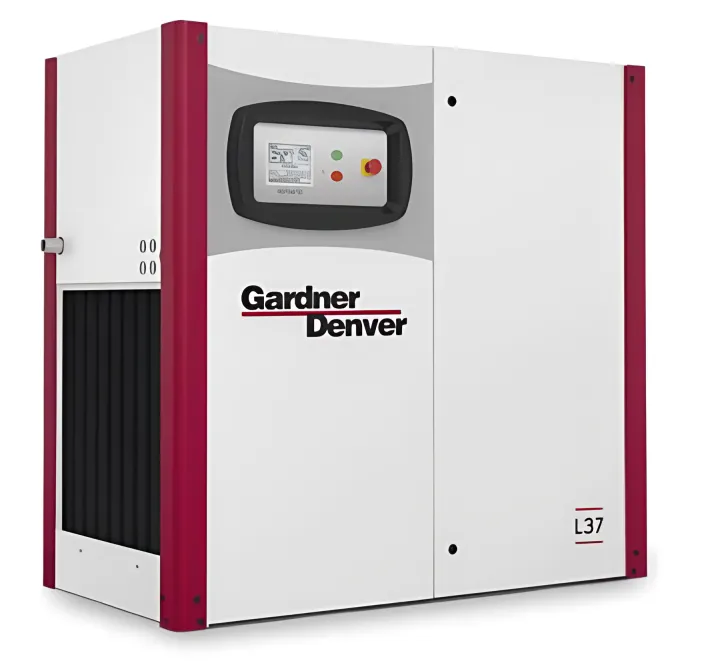
- Add a Gardner Denver variable-speed rotary screw (LRS Series or PureAir TVS for oil-free) as trim
- Use a master sequencer to coordinate loading: the VSD unit absorbs demand swings while the centrifugal unit holds steady at its efficient base-load point
Coordinating two compressor types across a single system is where control architecture matters. Gardner Denver's Governor touchscreen controller and iConn remote monitoring platform give plant engineers unified visibility across both unit types - tracking real-time diagnostics, load patterns, and fault alerts from one interface so maintenance teams can act on data before a minor issue escalates.
Automating Controls and Maintaining Centrifugal Compressors
Multi-Unit Control: Load Sharing vs. Cascading
Running multiple centrifugal compressors in parallel requires a different control strategy than rotary screw systems. Simple cascade control - where one unit loads fully before the next starts - pushes centrifugal units into inefficient blow-off at mid-range demand.
Load-sharing control, as described by Compressed Air Best Practices, works differently: it "bumps" pressure setpoints across all running units simultaneously, distributing flow evenly and keeping each machine away from its surge threshold. This approach reduces energy-wasting blow-off and protects the machines from repeated surge events.
Modern controllers like Gardner Denver's Governor touchscreen system handle this coordination with real-time diagnostics and remote monitoring via platforms like iConn - giving plant engineers visibility from a single interface rather than managing each unit independently.
Maintenance Priorities for Centrifugal Systems
While centrifugal compressors require less frequent routine maintenance than reciprocating designs, their high-speed rotating components demand specialized attention when service is due. Key maintenance checkpoints include:
- Bearing inspection - hydrodynamic and magnetic bearing condition monitoring, via vibration analysis
- Vibration monitoring - continuous or periodic trending to catch imbalance, misalignment, or bearing wear early
- Impeller condition - inspection for erosion, fouling, or damage at major service intervals
- Inlet guide vane function - verifying full range of motion and actuation response
- Filter servicing - inlet filtration protects impellers from particulate damage; intervals depend on ambient conditions
- Lube oil system (geared designs) - oil condition, pressure, and temperature monitoring per OEM schedule

Exact intervals should come from the OEM manual for the specific installed model - generic schedules don't account for design differences between geared and direct-drive magnetic-bearing configurations.
Comp-Air Ohio provides 24/7 emergency service for contract customers, backed by Gardner Denver OEM parts and factory-trained technicians - a practical consideration for Northern Ohio facilities where centrifugal compressors support continuous-process automation.
Surge Protection: Commissioning, Monitoring, and Ongoing Review
Repeated surge events put significant stress on bearings and impellers - and CAGI notes that while a single event won't necessarily destroy a well-designed compressor, repeated surging warrants immediate service review. Surge occurs when inlet flow drops below the machine's minimum stable operating point, triggering aerodynamic instability.
Modern surge protection systems use:
- Inlet guide vanes - modulate inlet flow before the surge threshold is reached
- Blow-off (unloading) valves - open to recirculate or vent air when flow drops too low
- Surge anticipation controls - monitor motor current or flow and act before aerodynamic instability develops
Surge protection must be properly commissioned at installation. Beyond that, review it whenever plant air demand changes significantly - adding or removing major equipment shifts the system operating point and can push a previously stable machine toward its surge boundary.
How Comp-Air Ohio Delivers for Your Plant
Comp-Air Ohio is the Gardner Denver air compressor dealer for Northeast Ohio, serving manufacturing plants, automotive shops, processing facilities, and commercial businesses from 9841 York-Theta Drive in North Royalton since 1977. The program covers Gardner Denver and CompAir rotary screw and centrifugal compressors, Hydrovane rotary vane units, Zeks dryers and Generon nitrogen generators, plus aftermarket parts, lubricants and filtration supplies. Your Cleveland, Akron, and Northern Ohio facility gets local sales, service, repair, maintenance, parts, compressed air audits, and electric rentals up to 300 HP, plus all-makes repair when uptime matters.
Explore related resources on our compressors, parts, dryers, aluminum piping, lubricants, compressor controls, nitrogen generators, and used equipment pages.
Ready for next steps? Request a quote, call Cleveland at (440) 237-6700, Akron at (330) 928-3092, or toll-free at (800) 247-7978.
Frequently Asked Questions
What RPM can centrifugal compressors operate up to?
Industrial magnetic-bearing turbo units like those from Tamturbo operate up to 35,000 RPM, while specialized gas-bearing designs from Celeroton reach 130,000–260,000 RPM. These extreme speeds require hydrodynamic, magnetic, or air foil bearings rather than conventional rolling-element bearings.
What software is used for centrifugal compressor performance monitoring?
Performance is tracked through OEM controller software paired with plant-level SCADA or compressor management systems, monitoring pressure, flow, temperature, vibration, and energy consumption. Gardner Denver's iConn remote monitoring platform is one example Comp-Air Ohio supports locally.
Are centrifugal air compressors oil-free?
Yes - centrifugal compressors are oil-free by design, as the impeller compresses air without lubricant in the air path. This makes them well-suited for applications requiring ISO 8573-1 Class 0 air quality. Class 0 is a certification claim requiring documented testing for specific equipment, not an automatic designation for every installation.
What is the difference between centrifugal and rotary screw compressors?
Centrifugal compressors use dynamic compression, converting kinetic energy to pressure, while rotary screw compressors use positive displacement via interlocking rotors. Centrifugal units excel at high, steady base-load flows with oil-free output; rotary screw VSD units handle variable demand across a wide turndown range. Most large plant air systems benefit from pairing both.
What flow capacity do centrifugal air compressors handle?
Flow ranges vary by OEM and model. Single-stage and multi-stage centrifugal packages span from hundreds to tens of thousands of CFM. The most common industrial plant air deployments fall in the 1,000-5,000 CFM range.
How do centrifugal compressors handle variable air demand?
Centrifugal compressors aren't well-suited to handle variable demand on their own. CAGI documents a 30–40% turndown limit before surge risk, so pairing them with a variable-speed rotary screw trim compressor is standard practice. Master load-sharing controls coordinate both technologies to minimize blow-off waste and keep each unit in its efficient operating range.