
Unlike refrigerated dryers, desiccant systems depend on the adsorptive capacity of their media, the mechanical integrity of switching valves, and precisely timed regeneration cycles. When any one of those elements degrades, air quality follows. The consequences range from moisture breakthrough and downstream corrosion to product contamination events that trigger compliance failures.
The risks of deferred maintenance are disproportionate in desiccant systems: oil-saturated desiccant requires full bed replacement, valve failures disrupt regeneration entirely, and drain failures allow liquid water to reach media that may survive other stresses but not that one. Siemens' 2024 True Cost of Downtime report puts unplanned manufacturing downtime at up to $2.3M per hour for automotive lines - context that reframes dryer maintenance as a production risk control, not a utility expense.
This guide covers maintenance types, component-level inspection tasks, warning signs, and a practical schedule for keeping desiccant dryers at peak performance.
Key Takeaways
- Oil contamination from failed pre-filtration requires full desiccant replacement - making pre-filtration your most critical maintenance point
- Desiccant media lasts 3–5 years in heatless dryers and 2–3 years in heated types under normal conditions
- Switching valves, purge mufflers, and drain valves all have specific service intervals that are frequently overlooked
- Filter elements should be replaced every 8,000 operating hours or 12 months, whichever comes first
- Preventive maintenance costs a fraction of emergency desiccant replacement or unplanned production downtime
Why Desiccant Air Dryer Maintenance Matters
Why Desiccant Air Dryer Maintenance Matters
The Performance and Cost Case
Three mechanisms explain most desiccant dryer failures - and none of them are unpredictable:
- Oil contamination of the desiccant bed blocks water adsorption
- Valve malfunction disrupts the regeneration cycle
- Inadequate filtration allows liquid water ingestion into the bed
All three are preventable with consistent maintenance.
According to Van Air Systems, compressor lubricant coats the porous surface of activated alumina and blocks water adsorption entirely. The dryer continues to cycle, but the dew point rises. By the time the downstream sensor catches it, the bed is fully compromised. Costs stack up fast: bed replacement, production downtime, and decontaminating downstream equipment that received wet air.
Purge air waste compounds the energy side of deferred maintenance. Heatless desiccant dryers consume 15–20% of their rated flow as purge air under normal operation. A degraded or incorrectly set system purges more than it should - energy you're paying for without improved drying performance.

Compliance Exposure
For facilities operating under ISO 8573-1 air quality standards, a poorly maintained desiccant dryer is a direct compliance liability:
| ISO 8573-1 Water Class | Pressure Dew Point | Typical Application |
|---|---|---|
| Class 1 | ≤ -70°C | Ultra-critical pharmaceutical, lab |
| Class 2 | ≤ -40°C | Standard desiccant dryer target |
| Class 3 | ≤ -20°C | Less demanding dry-air use |
FDA 21 CFR 117.40(g) also requires that compressed air introduced to food or food-contact surfaces be treated to prevent contamination - meaning a dew point exceedance in a food plant is a regulatory event, not just a maintenance issue.
Types of Desiccant Air Dryer Maintenance
The right maintenance approach depends on dryer type - heatless, heated purge, or heated blower purge - along with operating hours, ambient conditions, and air quality requirements. There is no universal interval that fits every installation.
Routine and Preventive Maintenance
Preventive maintenance covers the scheduled inspection and servicing of components that keep the dryer running between major overhauls.
Pre-filter and after-filter service tops the priority list. Both industry guidance and Parker specify filter element replacement at 8,000 operating hours or 12 months - whichever comes first - regardless of differential pressure readings. Van Air adds a field trigger of approximately 5–10 psid for pre-filters in dirty environments. Don't wait for pressure drop alone; contaminated elements that still flow adequately may be bypassing coalesced oil.
Automatic drain valve testing on pre-filter sumps should happen at every shift or daily check. A drain valve that fails closed allows liquid condensate to accumulate and eventually carry into the desiccant bed.
Purge muffler inspection catches one of the most commonly missed failure triggers. Desiccant fines accumulate in mufflers over time, creating back pressure that interferes with the depressurization phase of regeneration. If you see desiccant dust at the muffler exhaust, that's a muffler replacement trigger and a sign the desiccant is breaking down.
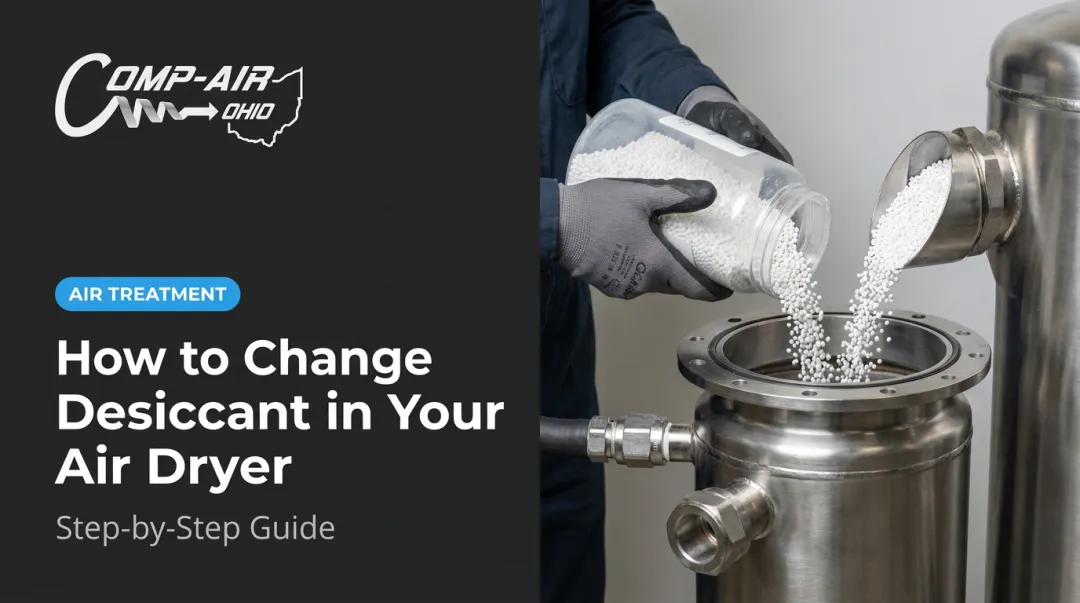
Desiccant bead sampling requires no full tower access - pull a sample from tower ports periodically and inspect for:
- Discoloration or darkening (oil contamination)
- Rounded, abraded beads (physical breakdown reducing surface area)
- Fines or dust (structural failure of the bead)
- Normal appearance: uniform, angular white/off-white beads

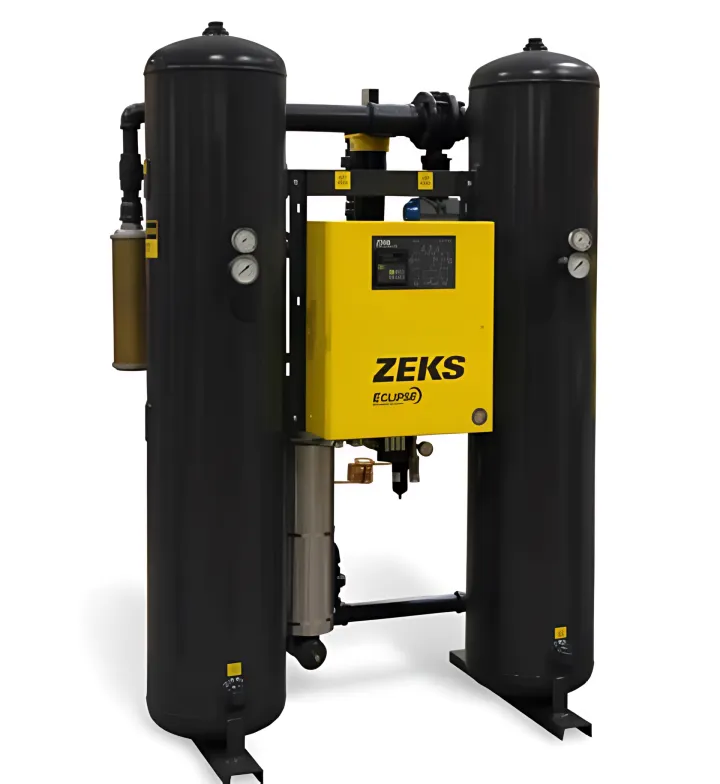
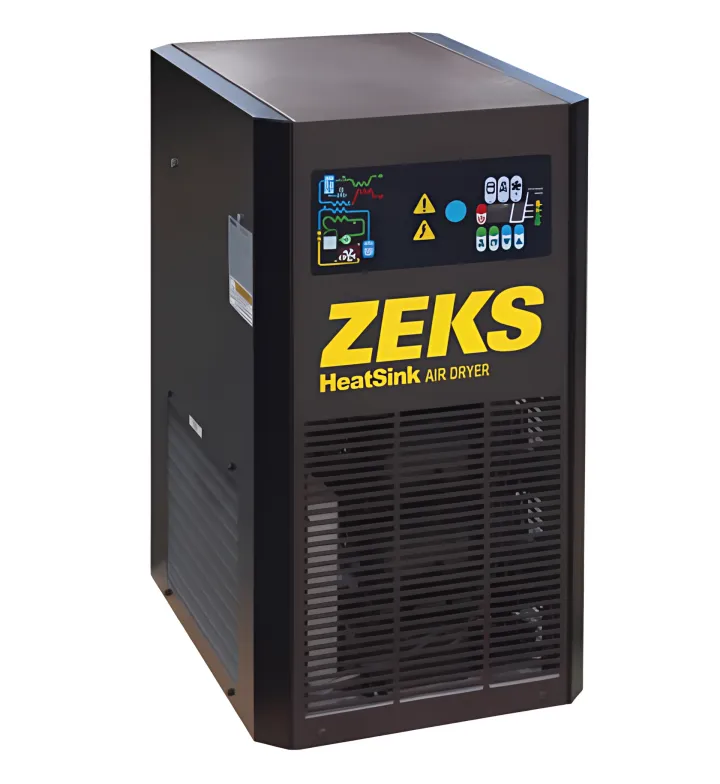
ZEKS Eclipse dryers - the desiccant line carried by Comp-Air Ohio - include removable stainless steel diffuser screens and accessible fill and drain ports specifically to make this kind of routine access practical without extended downtime.
Corrective and Reactive Maintenance
Reactive maintenance is triggered by confirmed failures, including:
- Dew point exceedance beyond spec
- "Failure to switch" alarm on the control panel
- Drain malfunction that allowed liquid into the dryer
- Desiccant dust appearing downstream
The cost of reactive-only strategies compounds quickly. A single oil contamination event can require valve rebuilds, downstream filter replacement, and equipment cleaning on top of the bed replacement itself. On a large dryer, that combination of parts, labor, and unplanned downtime typically costs several times more than a scheduled overhaul would have.
Predictive and Condition-Based Maintenance
Modern desiccant dryers support a data-driven maintenance approach through dew point sensors, mid-tower humidity sensors, and pressure transducers. The central benefit is demand-based purge control: rather than regenerating on a fixed timer, the dryer switches based on measured moisture load.
Compressed Air Best Practices reports that dew point-dependent switching can cut purge demand by 45–50% under part-load conditions compared to fixed-cycle operation. For oversized dryers or variable-flow applications, that's a measurable energy recovery.
Dew point sensors require annual calibration. A drifted sensor can cause the dryer to purge continuously, under-regenerate, or mask a real dew point failure - so calibration functions as both a performance check and a diagnostic tool.
For larger systems, lab-based desiccant analysis using ASTM D2769 (static water adsorption) and ASTM D4892 (abrasion resistance) can quantify remaining bed capacity and estimate replacement timing before performance degradation forces your hand.
Major Overhaul Maintenance
A full desiccant dryer overhaul covers the components with the longest service intervals but the highest failure consequence:
- Desiccant media replacement - tower drain, bed reload, and diffuser screen reinstallation
- Switching valve rebuilds or replacement - including solenoids and pneumatic actuators; ZEKS ZPB models have a 5-year interval on stainless steel valves and 3-year on butterfly valves
- Heater element inspection and connection checks (heated dryers only)
- Blower motor bearing service and inlet filter replacement (blower purge dryers only)
- Dew point sensor recalibration - typically annual or every 8,000 hours

Use genuine OEM parts to maintain dryer performance and warranty validity. ZEKS provides a 5-year warranty on high performance butterfly and stainless steel angle seat valves. Using non-OEM components in valve rebuilds can void that coverage and introduce fit or cycle-time issues that aren't immediately obvious.
Comp-Air Ohio's Gardner Denver-authorized service team in Northern Ohio provides scheduled overhaul programs with OEM-certified parts, including 24/7 emergency response for contract customers - helping facilities plan downtime rather than react to it.
Warning Signs Your Desiccant Dryer Needs Maintenance
Degraded Air Quality or Dew Point Drift
A rising outlet dew point - air that no longer holds at -40°F or your specified target - is the primary performance warning. Common causes:
- Exhausted or oil-contaminated desiccant bed
- Incorrect purge timing or pressure settings
- Switching valve failing to redirect airflow between towers
Don't diagnose from a single point reading. Log dew point across multiple complete drying cycles. You're looking for whether the dryer sustains target performance throughout the full cycle - or whether it meets spec early in a drying cycle but degrades as the tower approaches saturation.
Unusual Noises, Pressure Readings, or Valve Behavior
During the depressurization phase, abnormal sounds or a "failure to switch" alarm points to one of three causes:
- Valve seal wear - leaking switching valves prevent proper tower isolation
- Clogged purge mufflers - back pressure disrupts the depressurization sequence
- Solenoid malfunction - the valve doesn't actuate on command
Higher-than-normal tower pressure during the purge cycle is a specific indicator of muffler restriction or a valve that isn't opening fully. The ZEKS Eclipse controller includes failure-to-shift alarms that monitor tower pressure for proper valve sequencing - use these alarms as active diagnostics, not just fault notifications.
Visible Contamination or Drain Failure
These are emergency indicators:
- Oil-stained or darkened beads at tower sample ports - contamination has reached the bed
- Liquid water or oil in the post-filter housing - the upstream drain failed and liquid reached the desiccant
- Desiccant fines downstream in filters or equipment - the bed is physically breaking down
Visible oil contamination downstream of the dryer requires immediate shutdown and full desiccant replacement. Continuing to run a contaminated bed drives oil deeper into downstream filters, instrumentation, and end-use equipment - turning a dryer repair into a full system flush.
Increased Energy Use or Excessive Purge Air Loss
Normal purge consumption for a heatless desiccant dryer is 15–20% of rated flow. A 1,000 CFM dryer should consume 150–200 CFM for regeneration. Deviations beyond this range indicate:
- A leaking switching valve allowing continuous purge flow
- Incorrect purge pressure or timing settings
- A desiccant bed that has lost adsorption capacity and requires longer regeneration cycles to achieve the same dew point
Track purge flow trends over time - upward drift is one of the earliest measurable warnings, often appearing weeks before dew point failure becomes apparent on instrumentation.

Desiccant Air Dryer Maintenance Schedule
Maintenance intervals vary by dryer type, operating hours, and inlet air quality. Use this table alongside your manufacturer's manual - facilities running three-shift continuous operations typically reach annual milestones at 8,000 operating hours rather than by calendar year.
| Frequency | Tasks |
|---|---|
| Daily | Check dew point indicator or controller status; inspect automatic drain valves on pre-filters for condensate discharge; note unusual noises or pressure alarms |
| Weekly | Check differential pressure gauges on pre-filters and after-filters; confirm towers are cycling and switching correctly; inspect purge muffler exhaust for desiccant dust |
| Monthly / Quarterly | Manually test drain valves; inspect control air filter/regulator; verify purge pressure settings against manufacturer specification; manually step through a complete operating cycle to confirm solenoid and switching valve function |
| Annual / 8,000 Hours | Replace pre-filter and after-filter elements; rebuild or replace switching valves and solenoids; recalibrate dew point sensors; replace purge exhaust mufflers; sample desiccant beads for contamination and abrasion; full electrical inspection of heater elements and temperature controls (heated dryers); service blower motor and inlet filter (blower purge dryers) |
| 2–3 Years | Plan desiccant media replacement for heated purge and heated blower purge dryers; earlier if contamination is detected |
| 3–5 Years | Plan desiccant media replacement for heatless dryers; conduct lab-based bead analysis on large systems to confirm timing |
Tighten the schedule if conditions demand it: Facilities dealing with high ambient dust, elevated inlet air temperatures, or oil carryover from the compressor should inspect pre-filters weekly and replace elements more frequently than the standard 8,000-hour interval.
Conclusion
Desiccant air dryer maintenance is not optional in applications where air quality matters. The cost of a single oil contamination event - bed replacement, valve rebuilds, downstream cleaning, production interruption - consistently exceeds the investment in a preventive maintenance program over several years.
The right approach covers four fundamentals:
- Protect the desiccant bed with maintained coalescing pre-filtration
- Verify performance with dew point and mid-tower humidity monitoring
- Schedule filter and valve service at 8,000 hours or annually
- Treat desiccant life as condition-based within the 2–5 year range, depending on dryer type and actual inlet air quality
For facilities in Northern Ohio, Comp-Air Ohio offers Gardner Denver-backed service plans that include scheduled maintenance, OEM parts support, and 24/7 emergency response for contract customers. Their factory-trained service team handles ZEKS Eclipse dryers across all configurations - heatless, heated purge, and blower purge - keeping overhauls on schedule and dew point targets on spec.
How Comp-Air Ohio Delivers for Your Plant
Comp-Air Ohio is the Gardner Denver air compressor dealer for Northeast Ohio, serving manufacturing plants, automotive shops, processing facilities, and commercial businesses from 9841 York-Theta Drive in North Royalton since 1977. Your Cleveland, Akron, and Northern Ohio facility gets local sales, service, repair, maintenance, parts, compressed air audits, and electric rentals up to 300 HP, plus all-makes repair when uptime matters.
Explore related resources on our compressors, parts, dryers, aluminum piping, lubricants, compressor controls, nitrogen generators, and used equipment pages.
Ready for next steps? Request a quote, call Cleveland at (440) 237-6700, Akron at (330) 928-3092, or toll-free at (800) 247-7978.
Frequently Asked Questions
How should desiccant air dryers be serviced?
Desiccant dryers require a layered service approach: daily drain and dew point checks, periodic filter and valve inspections, and annual overhauls covering desiccant sampling, valve rebuilds, muffler replacement, and sensor recalibration. Always follow the manufacturer's operating manual for model-specific intervals and procedures.
How often should desiccant be changed in an air dryer?
Activated alumina desiccant typically lasts 3–5 years in heatless dryers and 2–3 years in heated purge and blower purge dryers under normal conditions. Replace it immediately if oil contamination or severe liquid water ingestion has occurred. Waiting until dew point failure appears only worsens the damage and increases replacement costs.
How long do desiccant air dryers last?
With proper maintenance, a quality desiccant dryer can operate reliably for 15–20 years or more. The components with the most limited service lives (desiccant media, valve seals, and purge mufflers) are all serviceable and replaceable without replacing the dryer itself.
What are the signs of oil-contaminated desiccant?
Look for discolored or darkened beads at tower sample ports and oily residue in purge exhaust mufflers or post-filters. A persistent dew point failure that doesn't improve despite correct valve timing and purge settings is another red flag. Any one of these warrants immediate inspection; all three together means the bed needs full replacement.
What is the difference between heatless and heated desiccant dryer maintenance?
Heatless dryers have fewer components and lower maintenance complexity - no heaters or blowers - but consume more purge air (15–20% of rated flow). Heated and blower purge dryers require additional service points including heater element checks, temperature control calibration, and blower motor servicing, but use far less compressed air for regeneration.
Can I extend the life of desiccant in my air dryer?
Desiccant life is maximized by:
- Maintaining coalescing pre-filtration to exclude oil
- Ensuring drain valves function properly to prevent liquid ingestion
- Operating within rated flow capacity
- Conducting periodic bead sampling to catch problems early
Identifying contamination through sampling costs far less than responding to a dew point failure.