
According to industry guidance, a 75 HP compressor operating at 75°F and 75% relative humidity can generate 280 liters (75 gallons) of condensate in a single day. For Northern Ohio facilities running through humid summers, that number is a daily reality - not a worst-case scenario.
This guide covers why moisture forms, what it destroys, how dryness is measured, and which equipment combinations actually solve the problem across industrial, food, pharmaceutical, and medical applications.
Key Takeaways
- Compression concentrates water vapor until it condenses - moisture in compressed air is unavoidable without active removal
- Unchecked moisture causes corrosion, seal failure, bacterial growth, and product contamination
- Aftercoolers, separators, refrigerated dryers, desiccant dryers, and membrane dryers each target different dew point requirements
- ISO 8573-1 moisture purity classes (Class 1–6) give regulated industries a concrete compliance target
- Routine drain maintenance is as critical as having the right equipment installed
Why Moisture Forms in Compressed Air
Atmospheric air always contains water vapor. When a compressor reduces air to a fraction of its original volume, the air's capacity to hold that vapor drops sharply - and what can't be held condenses into liquid water inside the system. This is a basic physical outcome of compression, not a maintenance issue or equipment defect.
CAGI documents a clear threshold: at an 8:1 compression ratio (approximately 103 psig), air cooled back to its original temperature will form liquid water if the inlet relative humidity exceeds just 12.5%. In most real-world facilities, inlet air is well above that threshold year-round.
That baseline problem gets worse depending on where and how a facility operates.
Ambient Conditions That Amplify the Problem
High summer humidity sharply increases condensate volume. A 500 SCFM system operating at 90°F and 70% relative humidity, compressed to 100 psig, can produce 42.9 gallons of condensate in a single 8-hour shift - 35.8 gallons collecting in the receiver alone, with another 7.1 gallons forming downstream as the air continues to cool.

Two conditions make the problem worse in practice:
- High ambient humidity - Northern Ohio summers regularly push relative humidity above 70%, maximizing condensate generation during peak production months
- Temperature transitions - hot compressed air traveling from an outdoor compressor into an air-conditioned facility cools rapidly inside the piping, triggering additional condensation even after initial treatment stages
No climate, compressor type, or operating condition prevents this - which is why active moisture removal is a system requirement, not an optional upgrade.
The Real Cost of Moisture: Damage, Downtime, and Risk
Moisture damage doesn't announce itself. By the time a valve sticks, a cylinder fails, or a product batch gets condemned, the cost already exceeds what prevention would have required.
Equipment and Component Damage
Liquid water inside pneumatic components strips factory-applied lubrication, causes rubber seals to swell and deteriorate, and accelerates metal-on-metal wear. Moisture also washes lubricant from valve spools and actuator surfaces, leaving components running dry.
The downstream effects compound quickly:
- Rust forms on interior pipe walls, gradually restricting airflow
- Pipe scale breaks free and travels through the system as abrasive particles
- Precision orifices in valves and cylinders clog with rust particles and debris
- Directional control valve spools stick under combined corrosion and contamination load
Corrosion and Pipe Degradation
Water reacting with steel pipe creates rust that builds up on interior surfaces, narrowing the effective bore and reducing flow capacity. As that scale loosens, it migrates downstream and clogs the fine passageways that pneumatic components depend on.
Carbon steel piping is particularly vulnerable, which is one reason corrosion-resistant aluminum piping systems, like Gardner Denver's Quick-Lock and Big-Lock aluminum distribution systems carried by Comp-Air Ohio, are specified in moisture-sensitive installations.
Production, Quality, and Bacterial Risk
Industries where compressed air contacts products face a different category of risk entirely:
- Food processing and packaging - moisture carries bacteria, rust particles, and debris directly onto contact surfaces or into product streams
- Pharmaceutical and medical device manufacturing - FDA guidance on sterile drug production explicitly addresses microbial contamination risk from compressed gas condensate
- Automotive painting - even trace moisture causes adhesion failure, blistering, and finish defects
Beyond product contamination, standing moisture in air lines creates a breeding environment for mold and bacteria. Biological buildup reduces effective airflow, introduces viable microorganisms into process air, and poses direct health and safety risks to workers - a liability no food, medical, or pharmaceutical facility can afford to ignore.
How Moisture Is Measured: Dew Point and ISO 8573-1
Dew point is the temperature at which water vapor in air begins to condense into liquid. Lower dew point = drier air. A system with a –40°F dew point is dramatically drier than one at +38°F.
The relevant measurement inside a pressurized system is pressure dew point (PDP) - the condensation temperature at line pressure, not at atmospheric conditions. PDP is always higher than atmospheric dew point for the same air sample. That makes it the correct benchmark for specifying and verifying dryer performance - not the atmospheric figure.
ISO 8573-1 Air Quality Classes for Moisture
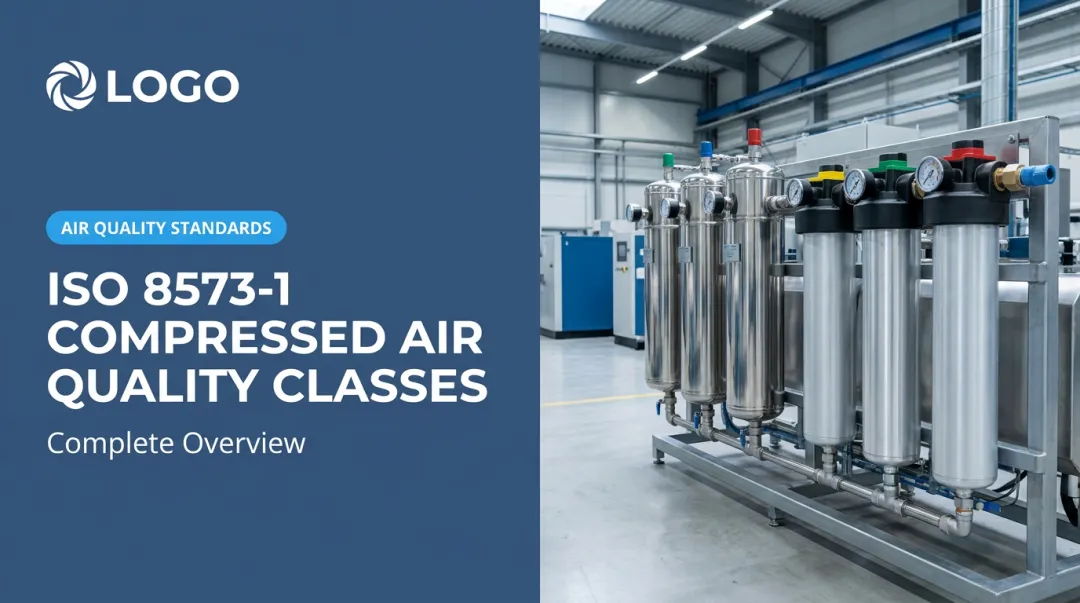
ISO 8573-1 is the international standard classifying compressed air purity across particles, oil, and moisture. For moisture specifically, Classes 1–6 are defined by pressure dew point targets:
| ISO Class | Pressure Dew Point |
|---|---|
| Class 1 | ≤ –70°C / –94°F |
| Class 2 | ≤ –40°C / –40°F |
| Class 3 | ≤ –20°C / –4°F |
| Class 4 | ≤ +3°C / +37.4°F |
| Class 5 | ≤ +7°C / +44.6°F |
| Class 6 | ≤ +10°C / +50°F |
Classes 7–9 define liquid water concentration limits, not PDP thresholds - an important distinction when specifying compliant equipment.
Matching Dew Point Requirements to Your Industry
| Application | Typical Requirement | Dryer Type |
|---|---|---|
| Pneumatic tools, woodworking, packaging | ~38°F PDP (Class 4–5) | Refrigerated dryer |
| Food and beverage (non-contact) | +3°C to –20°C PDP | Refrigerated or light desiccant |
| Food direct contact, pharma, medical | –40°F PDP (Class 2) | Desiccant dryer |
| Semiconductor, critical sterile processes | –70°C to –100°F PDP (Class 1–2) | High-performance desiccant |
| NFPA 99 medical air | Below 0°C / 32°F frost point at demand | Desiccant dryer |

The Complete Toolkit: Methods for Removing Moisture
Effective moisture removal is a staged process. Liquid, aerosol, and vapor each require a different mechanism - and no single device handles all three. The logical sequence moves from bulk liquid removal near the compressor toward precise vapor control at the point of use.
Aftercoolers and Receiver Tanks
An aftercooler is a heat exchanger installed immediately after the compressor. It drops the temperature of hot discharged air, causing the majority of water vapor to condense into liquid that drains off before entering the distribution system.
industry guidance reports that integrated aftercoolers can convert up to 70% of humidity into drainable condensate before air reaches any dryer. A wet receiver tank placed downstream adds residence time for further cooling and collection - reducing the moisture load on downstream dryers, which improves their efficiency and extends service intervals.
Comp-Air Ohio offers both air-cooled and water-cooled aftercooler configurations, available as factory-mounted options on compressor packages or as standalone components in system design projects.
Water Separators and Inline Filters
Water separators use centrifugal force or coalescing media to physically remove liquid droplets and aerosols from the air stream. They are essential as a first-stage filter before dryers - but they cannot remove water vapor, only liquid water already present.
ZEKS HDF Mist Eliminators, available through Comp-Air Ohio, handle coalescing filtration across capacities from 125 to 4,500 SCFM. These units use deep-bed filtration media and include differential pressure gauges to signal when service is needed.
Drain valves on separators matter. A separator that can't empty its bowl provides no ongoing protection. Comp-Air Ohio stocks zero-loss drain solutions including the ZEKS SDD200H pneumatically operated demand drain, which discharges condensate without releasing compressed air - eliminating the hidden energy waste of timer-based drain cycling.
Refrigerated Air Dryers
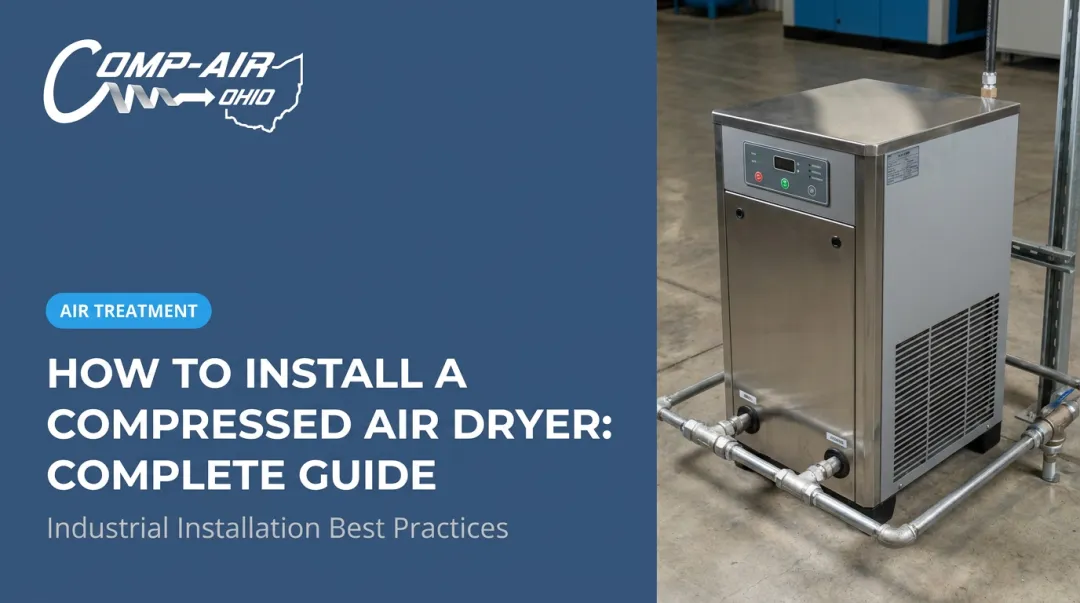
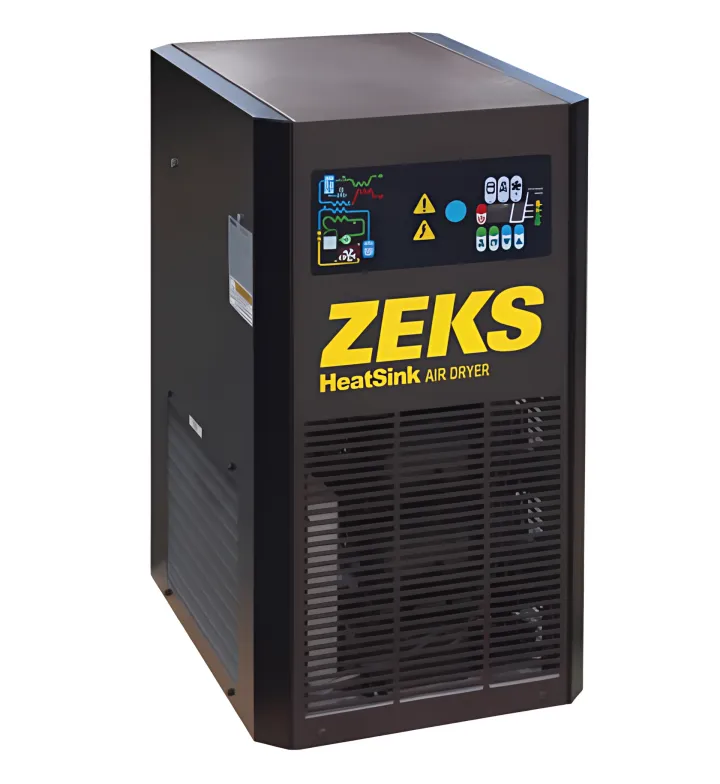
Refrigerated dryers chill compressed air to approximately 38–40°F, causing remaining water vapor to condense and drain, then reheat the air slightly to prevent condensation in downstream piping. They're the most common and cost-effective solution for the majority of industrial applications.
Comp-Air Ohio carries two main refrigerated dryer lines:
- ZEKS HeatSink Series - 10 to 2,400 CFM, 38°F standard PDP, patented stainless steel CFX heat exchangers with a 10-year warranty, true-cycling operation delivering up to 80% energy savings versus non-cycling designs
- Gardner Denver XGCY Series - 10 to 1,200 CFM, 38°F (3°C) PDP, 100% stainless steel construction, 99% efficiency centrifugal moisture separator, R410A refrigerant
Both lines are rated at standard conditions of 100°F inlet temperature, 100°F ambient, and 100 psig - the CAGI "three 100s" baseline.
Limitation: Refrigerated dryers cannot achieve dew points below freezing, and they're not appropriate for outdoor installations in climates where ambient temperatures drop below freezing.
Desiccant Air Dryers
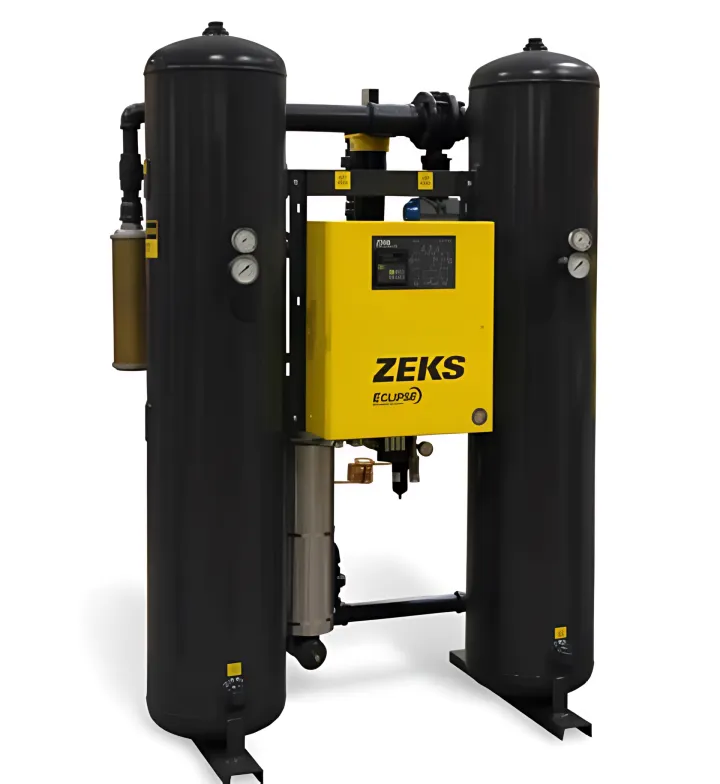
When freezing dew points, outdoor lines, or regulatory compliance require air drier than any refrigerated dryer can deliver, desiccant dryers are the right tool. They use adsorptive media - typically activated alumina - to chemically bind water vapor from the air stream, achieving –40°F to –100°F PDP. A regeneration cycle reactivates the desiccant bed using either a portion of dried air (heatless designs) or external heat.
Comp-Air Ohio's desiccant dryer options include:
- ZEKS Hydronix MPS Series - 20–60 SCFM, –40°F standard, –80°F and –100°F options, high-strength activated alumina
- ZEKS Eclipse ZPB Series - 90–5,000 SCFM, heatless regeneration, –40°F standard (ISO Class 2), –80°F and –100°F available
- Gardner Denver DGH Series - heatless, 3–5,400 CFM; DHP Series - externally heated, 100–4,000 CFM; DPB/GBPD Series - heat of compression, 350–10,000 CFM

Desiccant dryers are required for pharmaceutical production, food direct-contact air, medical and dental air (NFPA 99 compliance), semiconductor manufacturing, and any outdoor or unheated location where piping temperatures approach freezing.
Membrane Air Dryers and Point-of-Use Solutions
Membrane dryers use hollow polymer fiber membranes to selectively permeate water vapor while dry air passes through - no electricity required, no moving parts, minimal maintenance.
Gardner Denver's MES/MMD Series membrane dryers, carried by Comp-Air Ohio, cover 1.5–138 CFM and can achieve a –40°F dew point at the point of use. Their best fit is remote or portable applications, instrument air drops, or locations where electrical power is unavailable.
Membrane dryers do require clean, liquid-free inlet air - liquid water or oil aerosols degrade membrane performance. For that reason, they always follow upstream filtration and separation stages in a complete system design.
Prevention Best Practices for Long-Term Dry Air
Equipment alone doesn't guarantee dry air. System design and routine maintenance determine whether moisture removal actually works day after day.
Regular Draining and Condensate Management
No moisture removal device functions if condensate is never cleared from collection points. Every compressor tank, aftercooler, dryer, receiver tank, and piping low point needs to drain regularly.
Drain options compared:
| Type | How it works | Best for |
|---|---|---|
| Manual drain | Operator opens valve on a schedule | Small systems with dedicated attention |
| Timer-based automatic drain | Opens on a set interval regardless of condensate level | Simple automation, but wastes air when open |
| Zero-loss automatic drain | Opens only when condensate is present | Systems where air waste and reliability both matter |
For most industrial systems, zero-loss automatic drains are worth the investment. A timer drain with a 1/8" valve can pass approximately 100 CFM of compressed air when open - a significant ongoing energy cost over time.
System Design and Piping Choices
Two structural decisions matter most for moisture management:
- Take branch lines off the top of the main header - not the bottom. Condensate pools at the bottom of main runs; branch lines tapped from the top avoid pulling that pooled water into downstream circuits
- Use corrosion-resistant pipe materials - aluminum or stainless piping eliminates rust-based contamination that compounds moisture damage over time

Gardner Denver's Quick-Lock and Big-Lock aluminum piping systems, available through Comp-Air Ohio, are constructed from marine-grade aluminum rated to 300 PSI and 300°F, with a lifetime warranty. Unlike carbon steel, they won't corrode internally - so the piping itself never becomes a source of rust contamination in an otherwise clean air system.
Compressor Room Environment and Routine Maintenance
Keeping the compressor intake environment cool, well-ventilated, and dry directly reduces the moisture load entering the system. Good intake conditions mean less condensate to manage downstream - and less strain on every dryer and filter in the line.
Maintenance intervals to schedule:
- Inline filter elements: replace every 12 months (continuous operation basis)
- Refrigerated dryer pre-filter cartridges: replace annually per industry guidance FX series guidance
- Desiccant media life: expect 3–5 years for heatless designs, 2–3 years for heated designs (industry practice guidance); monitor dew point and pressure drop as indicators
- Automatic drain verification: check function at every maintenance visit - a stuck drain defeats the entire moisture removal system
Comp-Air Ohio offers preventative maintenance contracts and 24/7 emergency service for contract customers across Northern Ohio, with licensed refrigeration technicians on staff for dryer-specific service needs.
How Comp-Air Ohio Delivers for Your Plant
Comp-Air Ohio is the Gardner Denver air compressor dealer for Northeast Ohio, serving manufacturing plants, automotive shops, processing facilities, and commercial businesses from 9841 York-Theta Drive in North Royalton since 1977. Your Cleveland, Akron, and Northern Ohio facility gets local sales, service, repair, maintenance, parts, compressed air audits, and electric rentals up to 300 HP, plus all-makes repair when uptime matters.
Explore related resources on our compressors, parts, dryers, aluminum piping, lubricants, compressor controls, nitrogen generators, and used equipment pages.
Ready for next steps? Request a quote, call Cleveland at (440) 237-6700, Akron at (330) 928-3092, or toll-free at (800) 247-7978.
Frequently Asked Questions
Which device removes moisture from compressed air?
No single device does the whole job. Aftercoolers remove bulk condensate immediately after compression, water separators remove liquid droplets from the air stream, and air dryers (refrigerated or desiccant) remove water vapor. The right combination depends on your required outlet dew point and application.
What is the difference between a refrigerated and a desiccant air dryer?
Refrigerated dryers chill air to approximately 38–40°F PDP and suit most general industrial applications. Desiccant dryers reach –40°F to –100°F PDP and are required for pharmaceutical, food direct-contact, medical, dental, and semiconductor applications that demand freezing dew points.
How often should I drain my air compressor tank?
Tanks in regular use should be drained at minimum daily, with frequency increasing during hot and humid months. Automatic drain valves - particularly zero-loss designs - are strongly recommended to ensure draining happens consistently without manual intervention.
What are the signs of excessive moisture in compressed air lines?
Watch for:
- Water at fittings or tool connections
- Erratic pneumatic tool performance
- Rust or corrosion inside the system
- Unusual odors suggesting bacterial growth
- Drops in airflow or system pressure
Can moisture in compressed air cause health problems?
Yes. Moist air lines harbor bacteria and mold that can contaminate products or process air. Food processing, pharmaceutical manufacturing, dental practices, and medical device production all require ISO 8573-1 compliance and validated air quality monitoring for this reason.
How do I know which dew point my application requires?
Start with your industry's regulatory requirements and the sensitivity of your process or product to moisture. General industrial use typically needs a refrigerated dryer; food, pharma, medical, and semiconductor applications typically require desiccant drying to Class 2 or better. If you're unsure where your process falls, Comp-Air Ohio can audit your current system and identify the right dryer type for your dew point target.